
Global buyers are paying closer attention to convenient sports nutrition formats, including Glutamine Gummies. Demand is shaped by portability, taste, dosage clarity, and supplier reliability. Gummies can sit neatly beside shaker bottles, travel packs, and recovery products. Yet, product quality is not visible through packaging alone.
Grand View Research identifies dietary supplements as a large and expanding global category, driven by wellness awareness, sports participation, and online retail. Its market analysis also shows stronger interest in convenient delivery formats. However, most published reports group gummies within broader supplement categories. They rarely isolate glutamine gummies. That limitation matters when buyers compare market claims.
The Council for Responsible Nutrition’s industry surveys highlight consumer interest in quality, transparency, and trusted labeling. Meanwhile, USP quality standards provide useful reference points for identity, purity, and manufacturing controls. Buyers should examine certificates of analysis, batch records, allergen statements, stability data, and facility certifications. A polished website is not enough.
Ingredient sourcing needs careful review. Glutamine content should match the declared serving size, while sweeteners, colors, and gelatin or pectin should suit the target market. Buyers should also confirm shelf life under realistic shipping conditions, especially in hot and humid regions.
Clinical evidence for glutamine supplementation is not equally strong across all consumer groups. That point deserves honesty. Responsible suppliers avoid exaggerated recovery or medical claims and provide clear usage information. This guide compares leading Glutamine Gummies suppliers through documentation, manufacturing experience, customization options, minimum order quantities, and international fulfillment capability. Some supplier data may change quickly. Verification remains essential.
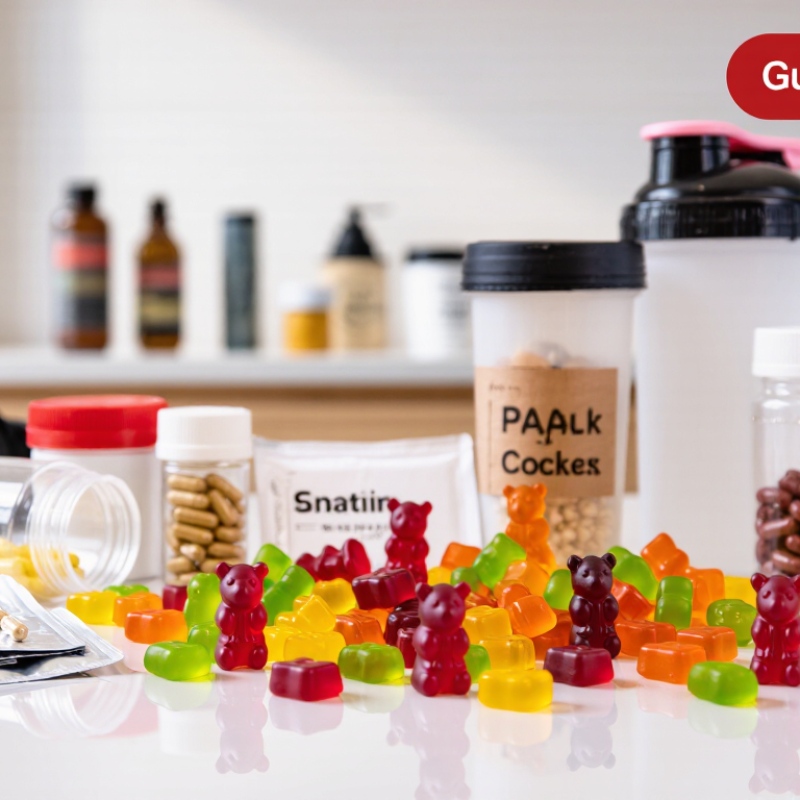
Glutamine gummies are chewable dietary supplements containing L-glutamine, an amino acid naturally found in the body. They may also include flavors, sweeteners, pectin, and supporting nutrients. L-glutamine participates in protein metabolism and serves as fuel for certain cells. However, a gummy is not automatically more effective than a powder or capsule. That distinction matters.
Their worldwide popularity comes from convenience. A small pouch fits easily beside gym gloves, travel documents, or an office notebook. The soft texture and fruit flavor can feel easier than swallowing capsules. Some active adults use glutamine products around training, while others choose them for simple daily supplementation. Personal experience varies, and marketing claims often sound stronger than the available evidence.
Global buyers should examine suppliers carefully. Reliable manufacturers provide ingredient specifications, batch testing, allergen statements, and clear serving information. Independent testing can help verify identity, strength, microbial safety, and heavy-metal limits. Buyers should also check sugar content, storage requirements, shelf life, and destination-country regulations. Gummies can melt in hot containers, which creates a practical shipping problem. They are supplements, not treatments, and people with medical conditions should seek professional advice before use. The format is appealing, but careful evaluation remains necessary.
What Are Glutamine Gummies and Why Are They Popular Worldwide?
Glutamine gummies are chewable dietary supplements formulated with L-glutamine, an amino acid involved in nitrogen transport and protein metabolism. Their convenient format, portability, and easy dosing make them attractive to consumers in international supplement markets. The chart shows the elemental composition of pure L-glutamine by mass, calculated from its molecular formula C₅H₁₀N₂O₃ and standard atomic weights.
Source: PubChem Compound Summary for L-Glutamine; elemental percentages calculated from the molecular formula and relative atomic masses.
Top Glutamine Gummies Suppliers for Global Buyers?
How to Evaluate Glutamine Gummies Suppliers and Product Quality
Choosing a glutamine gummies supplier requires more than comparing prices. Experienced buyers should request a complete specification sheet, recent certificates of analysis, and batch-level test results. The documents should confirm glutamine content, microbiological safety, heavy metal limits, allergens, and declared serving size. Ask who performed each test. Independent laboratories usually provide stronger evidence than internal checks alone.
Product quality appears in small details. A reliable supplier should explain raw material sourcing, manufacturing controls, and full batch traceability. Look for documented quality systems, controlled storage, and clear procedures for handling deviations. Gummies can absorb moisture, so examine seal integrity, water activity, texture, and stability data. A sample may taste acceptable on day one, then become sticky after several weeks. Test it under realistic shipping conditions.
Request samples from more than one production batch. Compare color, shape, flavor consistency, and laboratory results. Check whether the label matches the formula, including sweeteners, gelatin or plant-based alternatives, and added nutrients. Supplier communication also matters. Replies should be specific, dated, and supported by records. Be cautious when answers sound polished but lack evidence.
No evaluation is perfect. A strong audit can still miss a weak shipment. Keep retention samples and record receiving conditions. Sometimes buyers focus heavily on active content and overlook packaging performance. That mistake is easy to make. Reliable decisions come from repeated checks, not one attractive sample.
| Evaluation Dimension | What Global Buyers Should Verify | Recommended Evidence | Suggested Weight | Quality Priority |
|---|---|---|---|---|
| L-Glutamine Identity | The finished gummy should contain L-glutamine as the declared active ingredient, with the identity confirmed by an appropriate laboratory method. | Raw-material specification, identity test, finished-product specification, and batch-specific certificate of analysis. | 15% | Critical |
| Declared Potency | Confirm the amount of L-glutamine per gummy and per serving, including the serving size used on the product label. | Assay results from an independent or qualified laboratory, product specification, and label-to-test reconciliation. | 15% | Critical |
| Manufacturing Compliance | Assess whether the facility follows applicable dietary-supplement good manufacturing practices and maintains documented quality procedures. | Current GMP certificate, audit report, corrective-action records, quality manual, and manufacturing-site details. | 15% | Critical |
| Microbiological Safety | Review testing for total aerobic microbial count, yeast and mold, and relevant pathogens according to the destination market and product risk assessment. | Batch-specific microbiological report, laboratory method, sample date, acceptance criteria, and laboratory qualification records. | 12% | Critical |
| Heavy-Metal Control | Verify control of lead, arsenic, cadmium, and mercury in accordance with the legal requirements of the target market. | Recent heavy-metal test report, analytical method, detection limits, raw-material risk assessment, and supplier approval records. | 10% | High |
| Allergen and Dietary Claims | Check whether the gummy contains gelatin, dairy, soy, gluten, artificial colors, or other substances relevant to the intended consumer group. | Full formula, allergen statement, ingredient declarations, cross-contact controls, and claim-substantiation documents. | 8% | High |
| Stability and Shelf Life | Confirm that potency, texture, appearance, and microbiological quality remain within specification throughout the stated shelf life. | Real-time or accelerated stability protocol, time-point results, packaging specification, storage conditions, and expiry rationale. | 10% | High |
| Gummy Texture and Uniformity | Evaluate weight variation, shape, color, taste, chewability, stickiness, and ingredient distribution across production batches. | Approved product standard, sensory evaluation records, in-process controls, weight checks, and retained-sample review. | 6% | High |
| Packaging and Tamper Evidence | Check protection from moisture, heat, oxygen, and contamination, together with suitable tamper-evident packaging for international distribution. | Packaging specification, seal-integrity test, moisture-barrier information, transport simulation, and packaging compliance documents. | 5% | High |
| Traceability and Recall Readiness | Ensure each batch can be traced from raw materials through manufacturing, packaging, shipment, and customer distribution. | Batch-number system, material-receipt records, mock-recall results, complaint procedure, and retention-sample policy. | 4% | Critical |
Reliable glutamine gummies manufacturing is concentrated in regions with mature supplement regulations and strong quality systems. North America offers experienced facilities, clear batch documentation, and advanced testing laboratories. Manufacturers there often support private-label production, stability testing, and flavor development. However, production costs can be higher, especially for smaller international orders.
Europe is another dependable sourcing region. Facilities in Germany, the United Kingdom, Italy, and nearby markets commonly follow strict food-supplement controls. Buyers should request evidence of GMP certification, ingredient traceability, allergen management, and independent laboratory results. Detailed records matter. A clean factory tour is useful, but it cannot replace batch-level testing.
East Asia, especially Japan, South Korea, and selected Chinese manufacturing centers, provides strong formulation expertise and efficient large-scale production. Southeast Asia is also developing capable facilities, although quality levels vary more between suppliers. I have found that factory location alone does not prove reliability. A polished website can still hide weak controls. Ask for recent certificates, sample testing data, production lead times, and export experience to your target market. Check whether the glutamine content matches the label after storage, not only before shipping. This step is sometimes overlooked. No region is perfect. Careful audits, transparent communication, and small trial orders remain essential for global buyers.
Global buyers should treat certification checks as a product-safety exercise, not a purchasing formality. The WHO estimates that unsafe food causes 600 million illnesses and 420,000 deaths each year. This wider food-safety risk makes supplier controls important, even for glutamine gummies. Request current HACCP or ISO 22000 certification, plus evidence of GMP compliance under the destination market’s rules.
In the United States, verify alignment with FDA 21 CFR Part 111 for dietary-supplement manufacturing, records, specifications, and quality testing. European buyers should review Directive 2002/46/EC and Regulation (EC) No. 1924/2006, especially ingredient status and health claims. Other markets may require separate product notifications, permitted-ingredient reviews, or local importer responsibility. One certificate is not enough.
Ask for batch-specific certificates of analysis covering glutamine identity, potency, microbial limits, heavy metals, allergens, and sugar content. Check whether testing comes from an ISO/IEC 17025-accredited laboratory. Stability data should support the stated shelf life under realistic heat and humidity conditions. Gummies can soften, discolor, or lose potency. That detail is often overlooked. The Council for Responsible Nutrition’s 2024 survey reported that 75% of U.S. adults use dietary supplements, increasing the need for credible labeling and traceability. Review warning statements, serving sizes, country-of-origin details, recall procedures, and three years of quality records where available. A careful buyer should also question gaps in documents; suppliers are not always perfectly organized.
Comparing glutamine gummy suppliers requires more than checking the unit price. Request a written quotation showing dosage, flavor, packaging, testing, and payment terms. A low price may exclude mold fees, artwork, samples, or export documentation. Calculate the landed cost per bottle, including freight, insurance, duties, and warehouse handling. Small details matter. Ask whether prices change at 5,000, 10,000, and 50,000 units.
Minimum order quantities can affect cash flow and product risk. A supplier offering 10,000 units may appear attractive, but confirm the shelf life before production. Check whether mixed flavors or trial batches are allowed. Request production samples and review texture, seal quality, label accuracy, and gummy weight. Independent laboratory reports should identify glutamine content, microbiological results, heavy-metal screening, and batch numbers. Manufacturing controls and traceable records support more reliable purchasing decisions.
Shipping services deserve equal attention. Compare production lead time, shipping method, carton dimensions, temperature protection, and tracking procedures. Air freight may reduce delays but increase cost. Ocean freight is cheaper for larger orders, yet schedules can shift. Confirm who prepares the commercial invoice, packing list, and certificate of analysis. Incoterms should be clearly stated in the contract. A common mistake is trusting an estimated delivery date without asking about port congestion or holiday shutdowns. Recheck every assumption.